A dinner cruise is one of those things people book on a Tuesday for a Wednesday, having read a price and a departure time and nothing else. That is usually fine. But the evening has a shape, and knowing the shape changes small decisions: when to leave your hotel, whether to eat beforehand (don't), when to arrive if you care where you sit, and whether the coat you are carrying is going to be a nuisance or the reason you enjoy the last hour.
What follows is our own sailing, described honestly, in the order it happens.
The evening at a glance
- Pier
- Cibali Pier, on the old-city shore of the Golden Horn, beside Kadir Has University — a short walk from the Cibali stop on the T5 tram
- Doors
- 20:00
- Departure
- 21:00, every night of the year
- Return
- Back alongside at Cibali between 23:45 and midnight
- Price
- €24.60 per person, all in — settled on board, not before
Before you leave the hotel
Two things decide whether the start of your evening is calm or a jog along the tram line.
The first is that the pier is not where most people assume. The cruise does not board at Eminönü or at any of the Bosphorus piers: it boards at Cibali, on a quieter stretch of the Golden Horn shore beside Kadir Has University, the long brick building on the water. The T5 tram stops at Cibali, a short walk away, and from Eminönü it is only two stops. From Sultanahmet, Sirkeci or Karaköy take the T1 to Eminönü and change; from Taksim, the M2 metro to Haliç station and ten or twelve minutes on foot along the shore. In a taxi, say “Cibali, Kadir Has Üniversitesi”. The exact map pin comes on WhatsApp once you have booked. Whichever way you come, allow a few spare minutes for the last stretch along a waterfront you do not know, in the dark.
The second is that the Bosphorus makes its own weather. On the water, at speed, after dark, it is reliably several degrees cooler than the street you left. In July that is the best thing about the evening. In March it is the difference between spending an hour on the open decks and spending five minutes there. Bring a layer even if the afternoon made it feel silly. Both salons are enclosed, heated and have panoramic windows, so nobody is ever forced outside — but the open decks at the bow and the stern are where the photographs are.
Do not eat first. The meal is genuinely a meal: ten kinds of cold meze, a warm börek, a main course you choose from four and the house semolina dessert. A late lunch is the easiest way to waste half of it. The full menu is set out here if you want to plan your day around it.
20:00 — the doors open
Boarding runs for the full hour before departure, and the hour is not padding. It exists because a boat that carries up to four hundred people cannot be filled in ten minutes, and because the crew would rather check names against a list slowly than quickly.
At the top of the gangway your reservation is confirmed and you choose your table. Tables are not assigned in advance; they are chosen on arrival, which is the best argument there is for coming early — whether you are two people or a group of fourteen, the earlier you board, the more choice you have. The one exception is the romantic table, a +€15 extra with candles and flowers, which is set up for you.
If you arrive at the front of the hour, the minutes on the open decks while the boat is still tied up are, quietly, one of the better parts of the night. The Golden Horn goes dark, the lights come on along the far shore, and nothing is moving yet. It is the only time all evening the view holds still.
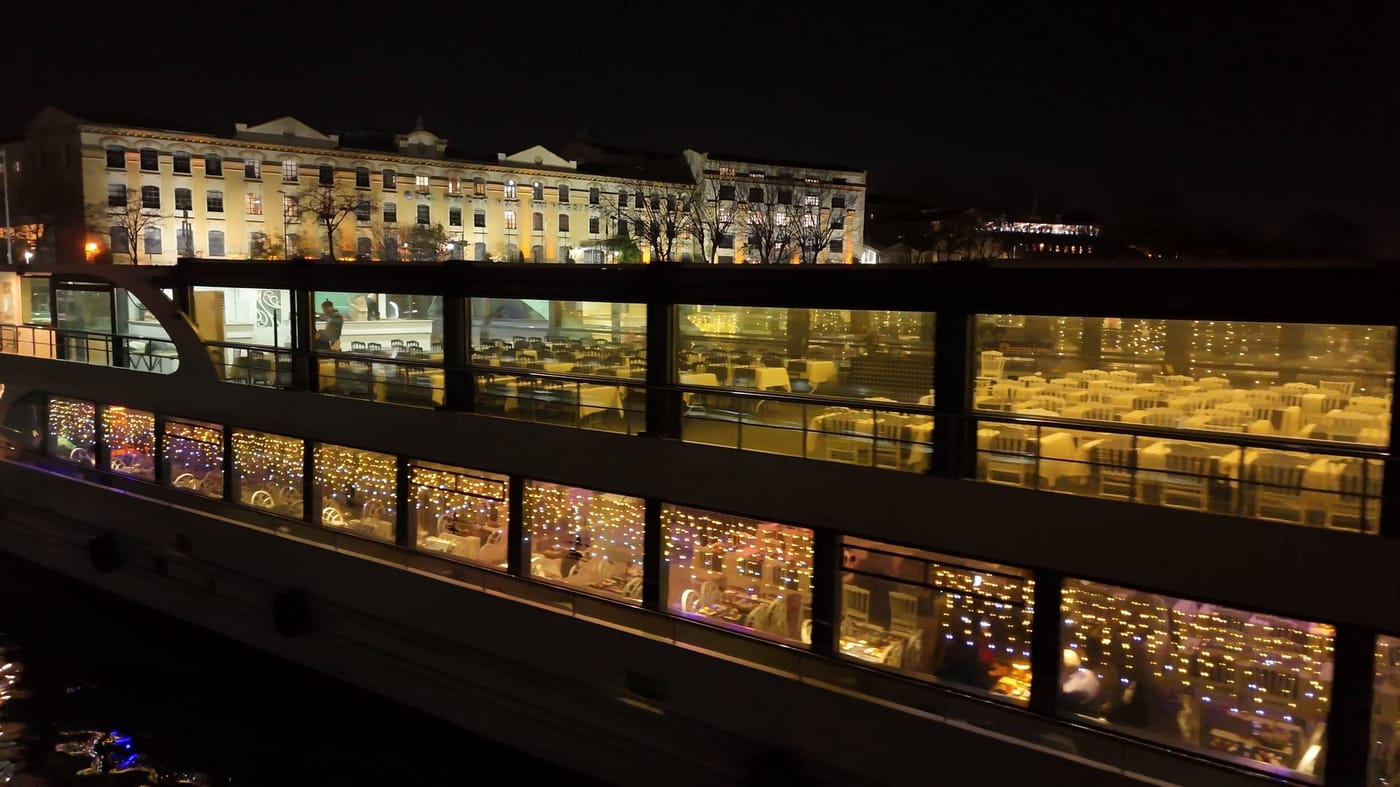
The meze comes first
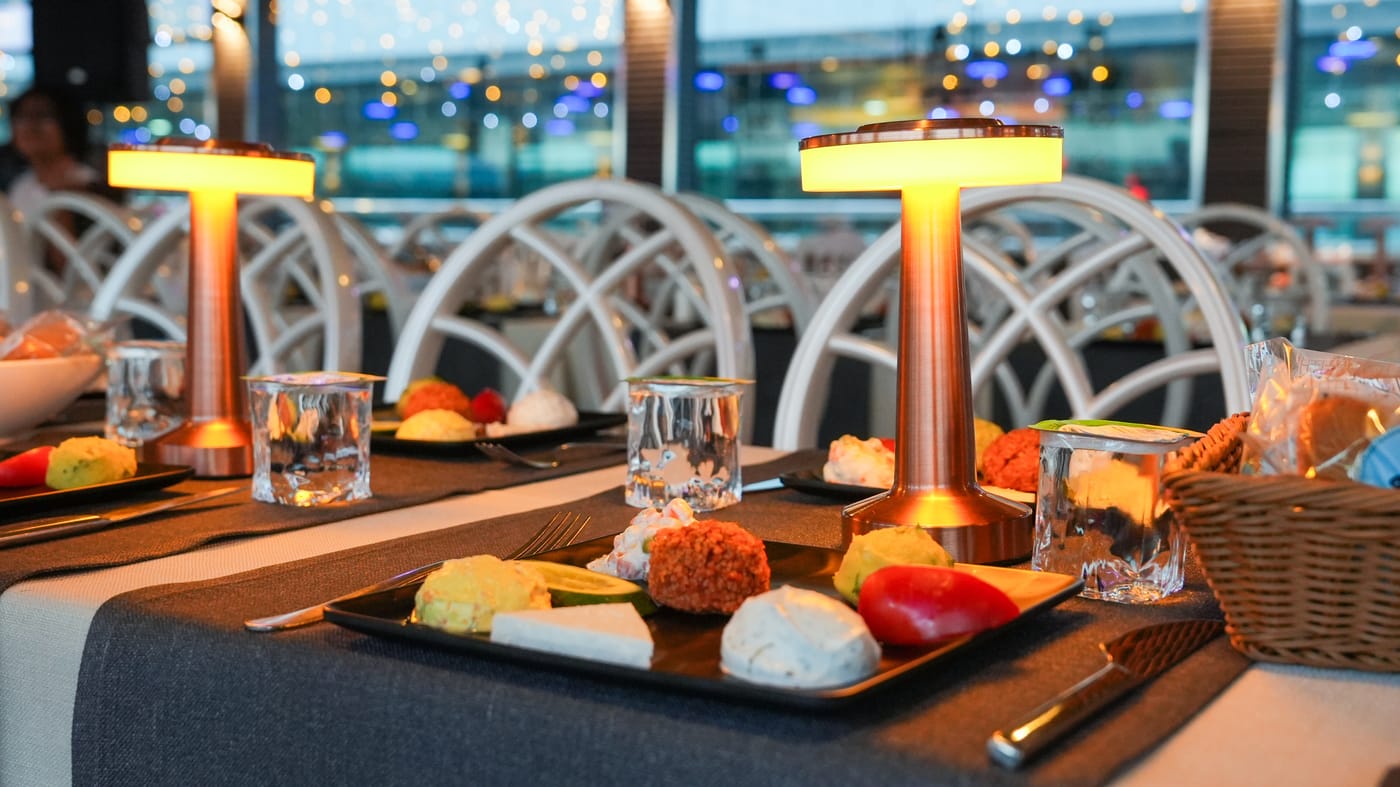
This surprises people. Once you are aboard and seated, the evening opens with the meze service, so the table fills before anything else has started: ten varieties of cold meze, brought family-style on a shared platter and meant to be eaten slowly.
There is a practical reason and a better one. The practical reason is that a full boat cannot all be served after departure. The better one is that it sets the tempo: you are eating and talking before anything has started, so when the boat slips out of the Golden Horn under the Galata Bridge, you are still at the meze and the cast-off happens around you rather than to you.
Soft drinks — water, cola, juice, tea — are unlimited and included for everyone, all night. Alcohol is the one thing the base price does not cover. If you want it, the drinks package is €15 per adult, unlimited all evening from the bar: beer, rakı, vodka, gin, and red and white wine. Imported drinks such as whisky, tequila and champagne, and cocktails, are charged separately at the bar. The package is optional, and alcohol is served from 18.
21:00 — casting off
The boat leaves at nine, and it leaves at nine. This is the single most useful sentence in this article: the departure is not approximate, and a guest still walking along the quay at 21:05 is a guest watching their evening leave without them.
Same-day bookings, incidentally, are accepted right up until 21:00 — if there is a table free at half past eight, it is yours. That is a different thing from arriving late for a booking you already hold.
The first stretch is the Golden Horn itself: down the inlet and out under the Atatürk Bridge and the Galata Bridge, with the Galata Tower above Karaköy on one side and Süleymaniye on the skyline on the other, then round Sarayburnu, the point of the old city, and into the Bosphorus. From there the boat runs north along the European shore: Dolmabahçe Palace, then Çırağan. If you care about the buildings more than the stage, this is the stretch to be out on the open decks for. We have written about what each of them is, and why they all face the water separately.
The main course, and which window to want
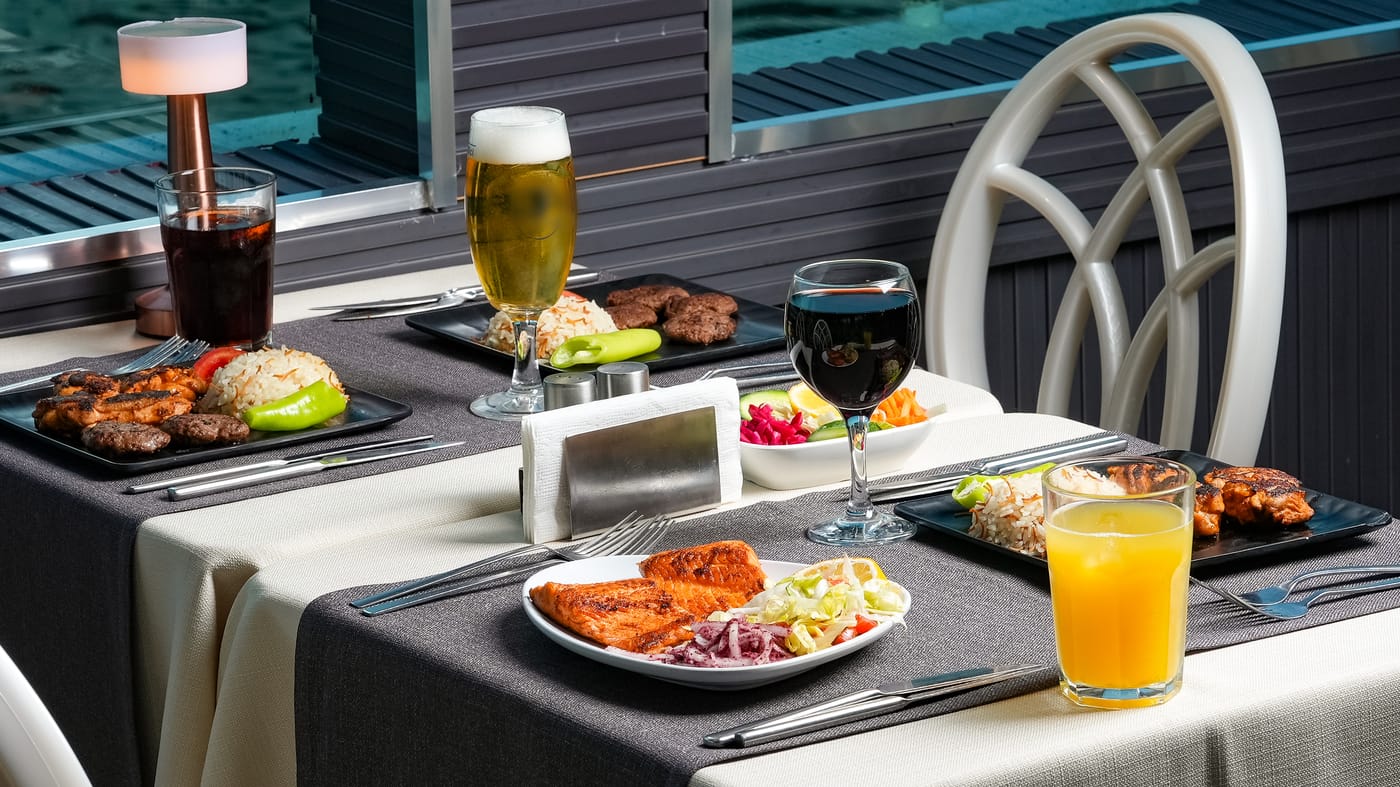
Once under way, the warm börek comes, and then the main course with a seasonal salad and garnish. Each guest picks one of four, and couples routinely order two different ones and swap: salmon, sea bass, chicken skewer or beef skewer. A vegetarian platter is prepared on request, at no extra cost, if you asked for it when you booked.
People ask which side of the boat is better. Honestly: neither, and that is the point of the route. The outward leg runs up the European shore, so the palaces are close on your left; at the Fatih Sultan Mehmet Bridge the boat comes about and runs home down the Asian side, so Beylerbeyi and Üsküdar are close on the other. Sit anywhere, wait an hour, and the good side becomes your side. Both salons have panoramic windows, and the stage is positioned to be visible from the tables.
The show, from your chair
The stage programme runs while dinner continues. This is deliberate and it is the thing most first-time guests get wrong in their heads: there is no interval, no dimming of lights and marching to a theatre. You stay where you are, the food keeps coming, and the room turns towards the stage between courses.
Eight acts, live, in an order that changes from night to night: the belly dance, the whirling dervish ceremony, Turkish Romani dance, Caucasian dance with the knife show, Turkish folk dances, a rhythm show of live percussion, live violin — and then the DJ. Because the order moves, no act has a clock time, and we will not pretend otherwise. If you want to know what you are actually watching — the dervish ceremony in particular rewards knowing — we have taken the programme apart act by act.
One small piece of advice: the dervish is the act to put your phone down for. It is a religious ceremony before it is entertainment, and slow turning does not photograph well in a moving room.
Dessert, the DJ, and the dance floor
Dessert — the house semolina dessert — lands as the live programme closes, and it doubles as a signal. The lights change, the DJ takes over on the dance floor in front of the stage, and the evening splits in two.
Some of the boat moves to the dance floor. The rest stay at their tables with a glass and watch the city go past, which is an entirely respectable choice. Nobody is made to dance and nobody is made to move. The open decks at the bow and the stern are a few steps away when the dance floor gets warm, and this is the hour when the layer you brought earns itself.
It is also, for what it is worth, the best hour for photographs. The return leg passes Beylerbeyi and Üsküdar lit from the water, the bridge changes colour behind you, and the rail of an open deck is the steadiest place on board to hold a phone.
23:45 — the last stretch
The run home passes Üsküdar and the Maiden's Tower — close enough to see it properly lit, far enough that it keeps looking like the thing on the postcard — then rounds the old city's point back into the Golden Horn, under the Galata Bridge again, to Cibali. Alongside between 23:45 and midnight, every night.
By then the city's trams are finishing for the night, so plan the last leg before you set out. A taxi is the simple answer — an app saves explaining where you are — and if you added the hotel transfer at €5 per person, the ride home is already arranged; pickups and drop-offs are organised by district, so the car may be shared. If you are working out how to get anywhere in this city after dark, our guide to Istanbul transport covers what runs late and what does not.
The practical things, in one place
| Question | Answer |
|---|---|
| When to arrive | Any time from 20:00. Tables are chosen on arrival, so earlier means more choice. |
| Dress | No dress code; smart casual is usual. Add a layer for the open decks, whatever the month. |
| Payment | On board, in cash (EUR, TRY or USD) or by card. No prepayment, no deposit, no online checkout. |
| Cancellation | Free until two hours before departure — that is 19:00 on the day. |
| Children | 0–3 free · 4–9 €19.60 · 10 and over full price. |
| Extras | Drinks +€15 per adult · hotel transfer +€5pp · romantic table +€15. |
| Languages | Reservations and questions on WhatsApp in 32 languages. |
Frequently asked
The evening itself
One departure, every night of the year. Doors at 20:00, away at 21:00, back at Cibali Pier between 23:45 and midnight. Dinner, the full Turkish night programme and unlimited soft drinks are in the price; you settle it on board, and you can cancel free until two hours before departure.
