Stand on the coast road at Beşiktaş and Dolmabahçe Palace presents you with a wall and a gate. Sit on a boat two hundred metres off it and the same building unfolds into the thing it was designed to be: a three-hundred-metre marble façade with its own quay, arranged for an audience arriving by sea.
That is true of nearly everything along this strait, and it is worth understanding why before you look at any of it.
The century the court came down to the shore
For four hundred years the Ottoman sultans lived at Topkapı, on the point above Seraglio Head, in a compound of courtyards and low pavilions that turned inward. It was a fortress-palace in the old style: power expressed by how little of it you could see.
In the nineteenth century that changed completely. The empire was remaking itself along European lines — the reform era known as the Tanzimat — and the architecture followed the politics. In 1856 Sultan Abdülmecid moved the court out of Topkapı and into a brand-new palace on the shore at Dolmabahçe: symmetrical, colonnaded, faced in marble, and unmistakably addressed to the water.
His successors kept building along the same shoreline. So did the wealthy, in wooden waterfront mansions called yalı, which line the strait to this day and which are also, invariably, at their best from the front — that is, from a boat. The Bosphorus in the nineteenth century was the city's main avenue, and everyone who could afford to built facing it.
The practical consequence: the standard land itinerary of Istanbul — Sultanahmet, Topkapı, the Grand Bazaar — is the old city and shows you almost none of this. The nineteenth-century city is a different city, it is strung along the water, and there is no way to see it properly with your feet on the ground.
Going north: the European shore
Dolmabahçe Palace
Opened in 1856 for Sultan Abdülmecid and built by the Balyans, the Armenian family who were the court's architects for most of the century. It cost an amount of money the treasury did not really have, which is part of its story. Baroque, rococo and neoclassical all at once, it was the seat of Ottoman power for the empire's last decades, and Atatürk died in a bedroom on the water side of it in 1938 — which is why clocks in the palace are traditionally set to 09:05.
From the water you get the whole length of it, plus the ornamental gate on the quay and the clock tower behind. At night it is lit, and the marble goes the colour of old paper.
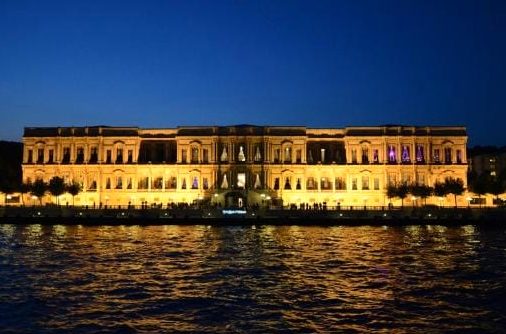
Çırağan Palace
A kilometre further up, and the last imperial palace built on the Bosphorus: finished in 1871 for Sultan Abdülaziz, again by a Balyan. It burned out in 1910, stood as a shell for most of the twentieth century, and was rebuilt in the 1990s as a hotel. It is the one building on this route where the pretty story and the sad story are the same story — a sultan's palace that is now somewhere you can book a room.
Ortaköy Mosque
Officially the Büyük Mecidiye Mosque, finished in the mid-1850s by the same architects, in the same neo-baroque register as the palaces — which is unusual for a mosque and is exactly the point of it. It sits on its own small promontory with the Bosphorus Bridge directly behind, and the two together make the single most photographed composition in Istanbul. From the water you get it straight on, with its reflection, which is the version on the postcards.
The Bosphorus Bridge
The first bridge ever to span the strait, opened in 1973 and now officially the 15 July Martyrs Bridge. A little over a kilometre of suspended roadway joining Europe to Asia, lit at night in colours that change. Passing underneath it is the moment most people on deck stop talking.
Bebek
A curved bay of waterfront mansions, cafes and a promenade — the calm, expensive, residential Bosphorus rather than the monumental one. Worth a look because it is what most of this shoreline actually looks like when it is not being a palace.
Rumeli Fortress
And then the register changes completely. Rumeli Hisarı is not nineteenth-century and not decorative: Mehmed II threw it up in 1452, in about four months, at the narrowest point of the strait, in order to cut Constantinople off from the Black Sea. The city fell the following spring. Three enormous towers and a curtain wall running straight down the hillside into the water, floodlit at night, and from a boat you see it the way it was meant to be seen — from the position of a ship that is not going to be allowed past.
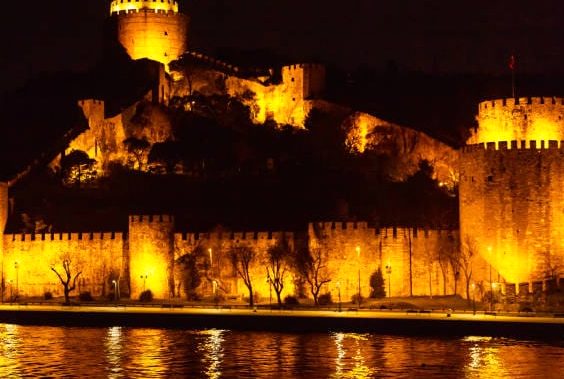
The second bridge, and the fortress facing Rumeli
Above Rumeli Hisarı the strait passes under its second crossing, the Fatih Sultan Mehmet Bridge, opened in 1988 and named for the sultan who built the fortress below it. Seeing the two in one glance is the point: a 1452 siege work and a 1988 suspension span, doing the same job of holding the narrows, five centuries apart.
On the Asian bank just there stands Anadolu Hisarı, the older and far smaller fortress — put up around 1394 by Bayezid I, some sixty years before Rumeli was thrown up opposite it. Between them they close the channel at its narrowest point, which was exactly the intention.
The boat comes about up here and starts back down the Asian side. It is the quietest few minutes of the evening on deck, because by then everyone has gone back inside for the main course.
Coming home: the Asian shore
Kandilli
The quiet Asian headland where the run home begins. No monument here, just steep wooded slopes, a scatter of wooden yalıs at the water and the current running hard past them — this is where the Bosphorus looks least like a bay and most like the river it functionally is.
Beylerbeyi Palace
The summer palace, finished in 1865 for Abdülaziz: smaller than Dolmabahçe, more restrained, and built for receiving guests rather than governing. The Empress Eugénie of France stayed here in 1869 on her way to open the Suez Canal, and reportedly had the windows of her room in Paris remade to match. It sits directly beneath the Bosphorus Bridge on the Asian side, which makes for an odd and rather good juxtaposition of 1865 and 1973 in one glance.
Kuzguncuk
A short row of painted wooden houses running back from the water, and one of the few places on the strait where a Greek church, an Armenian church, a synagogue and a mosque stand within a few hundred metres of one another. From the boat you get the colours; the rest of it needs the walk.
Üsküdar
The Asian heart of the city and much older than anything opposite it — this was Chrysopolis, a Greek town, before Constantinople existed. The waterfront is dense, low and busy, with Sinan's Mihrimah Sultan Mosque of 1548 standing right at the ferry landing. If the European shore is the nineteenth century performing, Üsküdar is the city getting on with it.
The Maiden's Tower
The small tower on its own islet just off Üsküdar, and the last thing you pass before Kabataş. There has been something on that rock since antiquity — a toll post, a customs point, a lighthouse, a quarantine station — and the building there now is essentially eighteenth century. Every version of its legend involves a prophecy, a princess and a snake, and no two guides tell it the same way.
We pass close enough for it to be properly lit and far enough that it keeps the outline everybody recognises.
How to actually see them
Three practical notes, in descending order of usefulness.
- Go at night, and go once by day if you have time. These are lit buildings on a dark strait, which flatters the palaces enormously; daylight flatters the hills and the yalıs. They are genuinely different trips.
- Don't fight for a side of the boat. On a route that goes up one shore and down the other, the good side changes at the turn. Anywhere is the right seat if you are prepared to wait an hour.
- Northbound is the busy half. Dolmabahçe, Çırağan, Ortaköy and the bridge come in the first twenty-five minutes, close together. If you want to be outside for anything, be outside for that.
Our own sailing leaves Kabataş at 21:00 and runs this exact route — north past the palaces, about under the second bridge, home down the Asian shore — with dinner and the stage programme going on inside. The hour-by-hour account of the evening sets out where you will be when, and the evening itself is here. Getting to the pier is covered in our Istanbul transport guide.
Frequently asked
The evening itself
One departure, every night of the year. Doors at 20:00, away at 21:00, back at Kabataş between 23:45 and midnight. Dinner, the full Turkish night programme and unlimited soft drinks are in the price; you settle it on board, and you can cancel free until two hours before departure.