A stage programme on a dinner boat is an easy thing to be cynical about, and plenty of them earn it. What makes this one worth paying attention to is that the four acts are not four variations on the same idea. They come from four different places, arrive in a deliberate order, and if you can see the order you get a much better evening than the guest at the next table who is watching costumes.
The programme runs while dinner continues — no interval, no move to another room, no dimming of the lights and a march to a theatre. It starts once the boat is under way and ends when dessert arrives.
The programme
- Act one
- Whirling dervish — the sema, slow and quiet
- Act two
- Folk dances of Anatolia and the Caucasus
- Act three
- Oba Dombra — the Central Asian rhythm, between the dance sets
- Act four
- Belly dance — the loudest the night gets
- Then
- Dessert, and the DJ with live saxophone until the pier
- Performers
- Professionally trained, with full-time stage and music careers
Why the order is the way it is
The programme climbs. It opens with the least spectacular thing on it and ends with the most, which is the opposite of how a variety show is usually built and exactly right for a room where people are eating.
At nine o'clock the boat is full of people who have just sat down, are halfway through a table of meze, and are still looking out of the window at Dolmabahçe. A loud opening would be shouted over. So the evening starts with something you can watch out of the corner of your eye and be drawn into, and by the time the room is finished eating it has been walked up to a point where four hundred people are clapping in time.
Act one: the whirling dervish
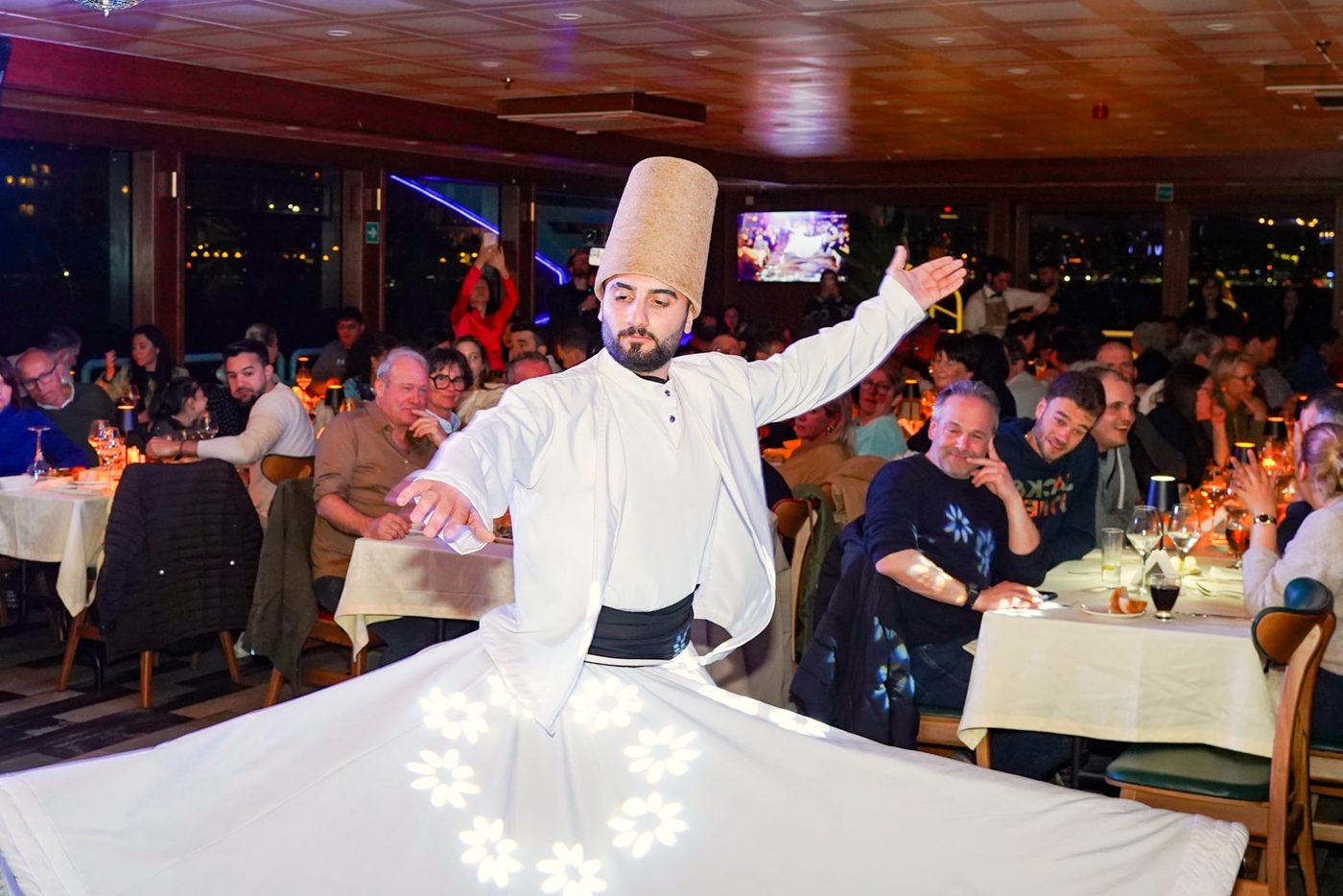
A single figure in a white robe and a tall camel-hair hat turns slowly on one spot, one palm open to the sky and one turned down to the earth. It goes on for several minutes. Nothing else happens.
What you are watching is the sema, the ceremony of the Mevlevi order, which grew up around the poet Jalal al-Din Rumi in Konya in the thirteenth century. Every part of it is meant: the tall hat stands for the tombstone of the ego, the black cloak discarded at the start for the tomb itself, the white robe beneath for the shroud. The upturned right hand receives from God, the downturned left passes to the earth, and the turning is the passage between the two. The Mevlevi sema is inscribed on UNESCO's list of intangible cultural heritage.
Two things follow from that, and they are the reason this act is first rather than buried in the middle.
The first is that it is genuinely a religious practice being performed as theatre, and it rewards being watched rather than filmed. Four minutes of slow rotation in a moving room is the single worst subject on this boat for a phone camera, and it is the single best one for simply looking at.
The second is atmospheric. A room that has just gone quiet for a dervish is a room that has agreed to pay attention, and everything after it lands on a better audience.
Act two: the folk dances
The second act is not one dance but a set of them, and they cover a lot of ground — more, in fact, than most guests realise they are being shown.
Sarı Gelin, from Anatolia
The melody is one of the most widely shared in the region: versions of Sarı Gelin are sung in Turkish, Azerbaijani, Armenian and Persian, each with its own words and its own claim on it. The song is a lament about a love that cannot happen. Danced, it stays slow and restrained, and it is the bridge out of the stillness of the dervish rather than a break from it.
An Azerbaijani medley
Azerbaijani dance is upright and precise — the back straight, the footwork small and fast, the arms doing most of the storytelling. If you have only ever seen “Turkish dancing” as a single idea, this is the point in the evening where the map gets larger: Baku is closer to this stage, culturally, than most of Europe.
A Turkish medley
Anatolia is not one dance tradition either. A medley moves between regions, and the changes of rhythm are the thing to listen for — the metre shifts under the dancers in ways that a Western ear reads as the music tripping over itself and a local ear reads as the province changing.
The Caucasian knife dance
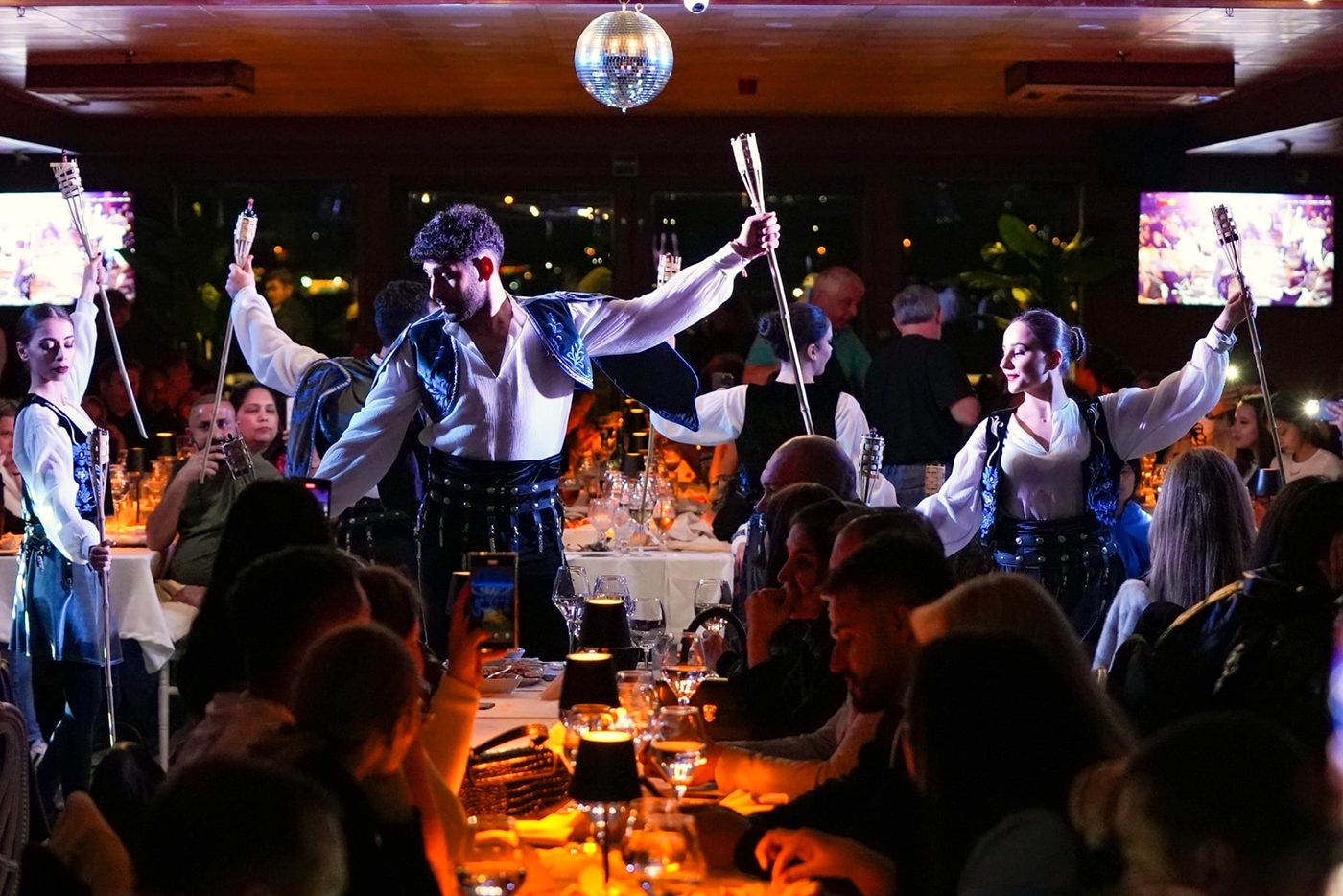
The set finishes in the Caucasus, with the dance that most reliably makes a dining room stop chewing: fast, martial, danced on the toes, with blades. It is a display of control rather than aggression — the whole point is how still the upper body stays while everything below it is moving very fast indeed.
Act three: Oba Dombra
Between the dance sets, the rhythm changes completely and the room usually notices before it understands why.
The dombra is a long-necked, two-stringed lute from the Central Asian steppe — the instrument of the Kazakh and wider Turkic nomadic tradition, played with a driving strummed pulse rather than picked melody. Oba is the word for a nomad encampment, the cluster of tents that moved together.
Putting it here is a deliberate piece of programming. The evening has spent twenty minutes travelling west to east across Anatolia and into the Caucasus; this act keeps going in the same direction, back towards where Turkic language and music came from before any of it reached this strait. It is also, practically, the moment the room starts clapping along, which is what the fourth act needs.
Act four: the belly dance
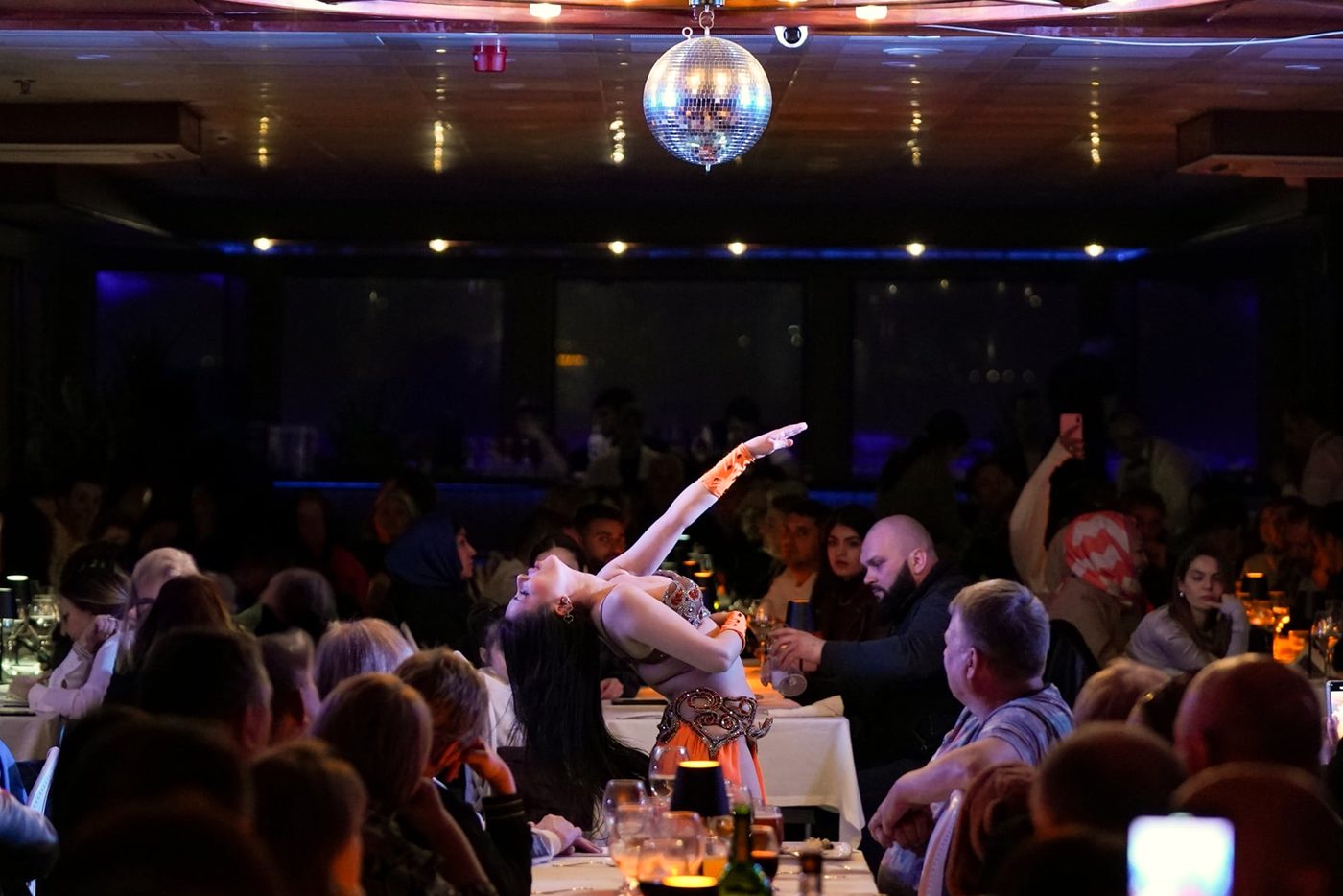
The centrepiece, and the loudest part of the night. A full routine from a professional dancer, working the stage and the aisles between tables, in the bright sequined costume everyone pictures when they hear the words.
Worth knowing: in Turkish this is oryantal dans, and in Istanbul it is a nightclub art form with a long professional lineage rather than a folk survival. The dancers who do it well have spent years on it, and what looks like improvisation is choreography with room built into it — including the audience moments, where a few guests get pulled gently up. If you would rather not be one of them, sit away from the aisle; nobody is dragged anywhere.
This is the act the phone comes back out for, and rightly. It is bright, it is fast, and unlike the dervish it is designed to be photographed.
Then the night changes gear. As the belly dance finishes, dessert lands, the lights change and the DJ takes over with a live saxophonist over the set. Half the boat goes up to the open deck to dance; the other half stays at the table with a glass and watches Üsküdar go past. Both are normal. The full shape of the evening is in the hour-by-hour account.
Getting the most out of it
- Every table sees the stage. It is positioned so that there is no bad seat in the salon, and the panoramic windows mean you are not choosing between the show and the Bosphorus — you are turning your head.
- Watch the dervish, film the belly dance. The first does not survive a phone screen; the last is made for one.
- Listen for the metre changing in the Turkish medley. It is the most interesting thing happening musically all evening and almost nobody notices it.
- The show is included. There is no premium seating, no ticket tier and no upgrade for a better view of the stage — the €24.30 is the whole evening. If you are marking an occasion, the romantic table (€15, candles and flowers) is about the table, not the sightline.
Frequently asked
The evening itself
One departure, every night of the year. Doors at 20:00, away at 21:00, back at Kabataş between 23:45 and midnight. Dinner, the full Turkish night programme and unlimited soft drinks are in the price; you settle it on board, and you can cancel free until two hours before departure.